Publications

Online bestellen


WAAM guideline & posters

WAAMMEC Project results

WAAM Tools

WAAM Welding parameters

WAAM Deposition strategies

WAAM Post-processing

Download poster Download poster Download poster


Publicaties


  • Manual, Cobot and Robot Welding? How to Make the Choice?

    There are several reasons why automation of welding production is gaining more and more importance. For example, skilled welders are nowadays scarce. Besides that, the weld quality obtained when using automatic welding processes has shown to significantly reduce the need for rework.

  • Comparison of Cobot and Manual Welding Based on Arc Parameters

    The present publication proposes an empirical evaluation of real-time quality monitoring of MIG/MAG welding of dissimilar high strength steels DP800 and DP1000 in T-joints based on the measurement of the processes parameters. A new strategy is proposed to evaluate the quality of the welds of HSS materials using the ISO 5817 standard. From the obtained results, a correlation between the process parameters and the quality of the weld was established. An operational comparison between cobot and manual welding was performed based on their repeatability. The results confirm the higher repeatability of the mechanised cobot process and the feasibility of using process parameters as an in-situ NDT technique for production control.

  • Unveiling the disguised complexities of Wire-Arc AM

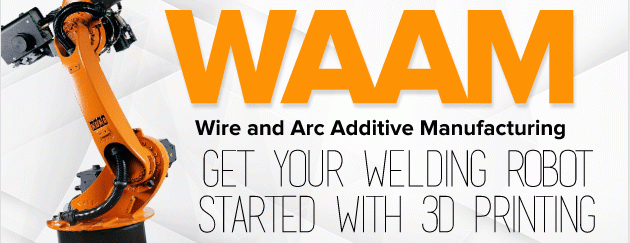
    Driven by the demand for increased manufacturing efficiency of engineering structures, WAAM which is also known as directed energy deposition-arc (DED-arc), can basically be seen as the integration of an “additive” principle in the wire-arc welding process.

  • Call for Papers BIL|NIL Lassymposium 2021

    BIL|NIL Lassymposium: November 17th & 18th 2021
    Deadline submissions: June 18th 2021

  • Call for Papers NIL|BIL Lassymposium 2020

    NIL|BIL Lassymposium: October 6 - 8, 2020
    Submission deadline: July 17, 2020

  • Acoustic emission as on-line tool for non-destructive inspection of welding

    The main objective is to investigate and develop a non-destructive quality control for friction spot welds by using acoustic emission monitoring. The influence of several welding parameters on the acoustic emission result was investigated and a standard setup with a minimum of background noise was developed. To get a better understanding of the acoustic emission technique, a second welding technique namely MIG/MAG robotic welding was investigated. 

  • Literature survey ultrasonic welding

    Ultrasonic welding is a ‘solid-state’ welding process that can be used to join similar or dissimilar materials, by applying high frequency vibration and normal pressure to the weld interface. The major advantage of this method is the low heat input at the weld interface. Because of the cold welding technique, ultrasonic welding can be used to join thin foils to thick sheets and the properties related to the heat at the weld interface are less significant. So welds such as aluminium to copper, aluminium to steel, etc. can be made. 

A question, remark or suggestion?